


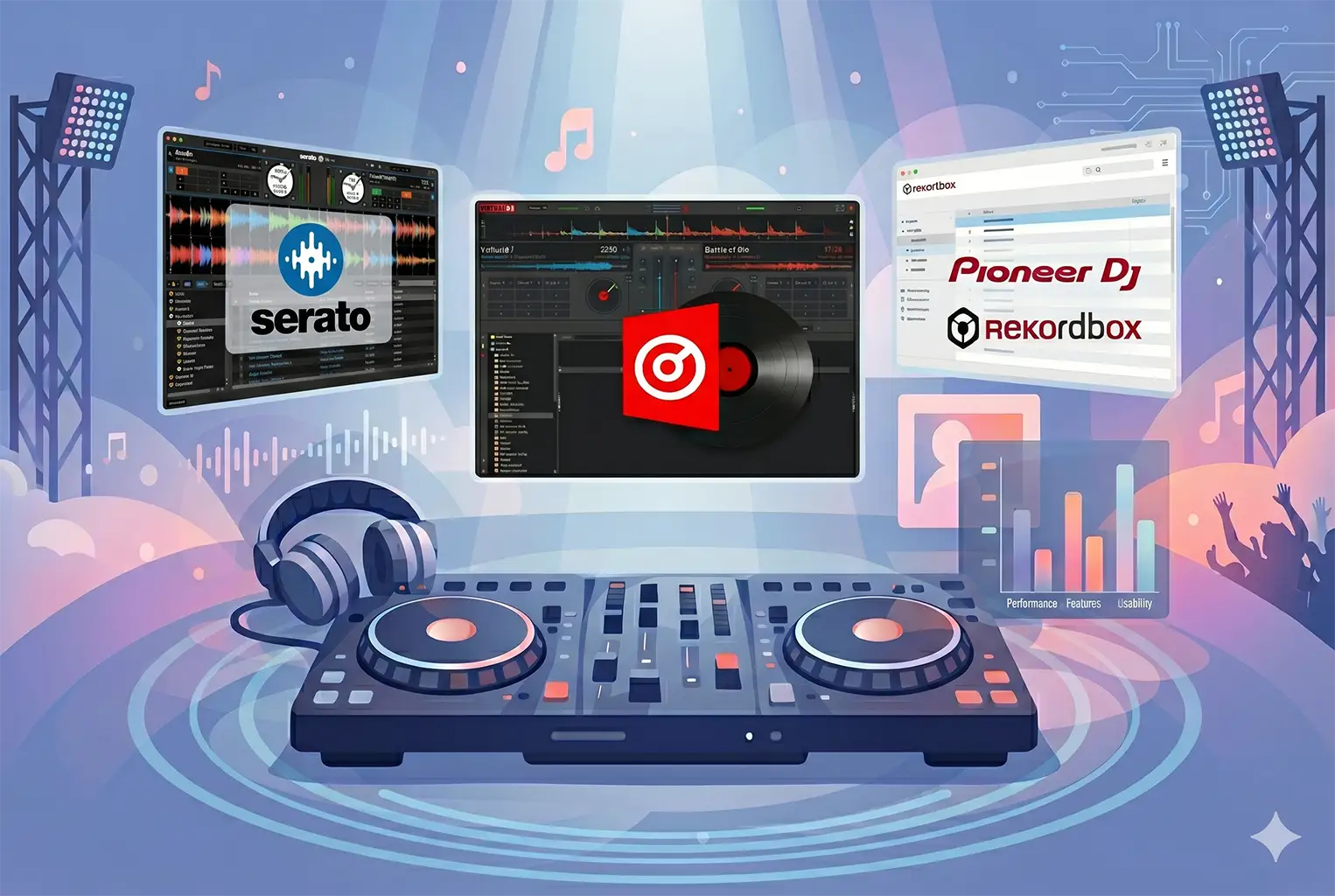
VirtualDJ vs Serato vs Rekordbox: Which DJ Software Should You Use in 2026?
Choosing the right DJ software? We compare VirtualDJ, Serato, and Rekordbox to help you find the best platform for your workflow, features, and performance needs.
The State of Digital DJing in 2025: Choosing Your Platform
DJ software has never been more powerful — or more divisive. What began as a digital replacement for crates and needles has evolved into an AI-driven performance platform where isolating live vocals mid-set or remixing stems in real time is standard practice. The gap between beginner and professional tools has narrowed dramatically, making the choice of the right platform both more important and more confusing than ever.
The market today centers on three dominant platforms: VirtualDJ, Serato, and Rekordbox. Each carries a loyal following, distinct hardware ecosystems, and a fundamentally different philosophy about what DJing should look like in practice. The "standard" choice — the one your local DJ mentor swears by — may not suit your workflow, budget, or creative ambitions.
VirtualDJ deserves special recognition here. Long before it became the go-to recommendation as the best DJ software for beginners, it was shaping world-class careers. Global superstars like Afrojack and David Guetta have publicly cited in DJ Mag VirtualDJ as the software where they learned the fundamentals. Its AI-powered separation technology now lets any DJ deconstruct tracks on the fly — a feature that blurs the line between mixing and live production.
On the other hand, legacy and ecosystem lock-in are real considerations that can outweigh raw features for working professionals.
Before you pick a platform, you need to understand the language — and the next section breaks down the core terminology shaping modern DJ tech in 2026.
Core Terminology: Understanding Modern DJ Tech
Before deciding which DJ software should I use becomes a question you can actually answer, you need a shared vocabulary. These platforms speak a technical language — and knowing the terms makes every comparison sharper.
Here are the four concepts that define modern DJ software:
**Real-Time Stem Separation**
The ability to isolate individual elements — vocals, drums, bass, and melody — from any track on the fly, without pre-processing. VirtualDJ pioneered this approach with its stem isolation technology, introducing it to the mainstream market back in 2020 via its advanced AI processing, according to Digital DJ Tips.
**MIDI Mapping**
The process of assigning hardware controls — knobs, faders, buttons — to specific software functions, allowing DJs to customize their workflow around any controller.
**Plug-and-Play Support**
Native hardware integration that requires zero manual configuration, meaning a controller connects and works immediately without custom driver setup or mapping.
Understanding these pillars matters because each platform handles them very differently — which is exactly what the head-to-head comparison ahead will reveal.
Before evaluating any DJ software, confirm it supports your specific hardware and workflow requirements using these four criteria.
Head-to-Head: VirtualDJ vs. Serato vs. Rekordbox
Choosing the best DJ software in 2026 comes down to four practical dimensions: hardware compatibility, AI toolset maturity, learning curve, and what you'll actually pay. Here's how the three platforms stack up at a glance.
Platform | Hardware Support | AI Features | Innovation Speed | Beginner Friendliness |
|---|---|---|---|---|
VirtualDJ | 300+ controllers natively — the industry's largest library, per DJ TechTools analysis | Best-quality stems, multiple innovative AI features | Fastest — ships features years ahead of rivals | High; free version removes nearly every barrier |
Serato | Strong, but limited to certified partner hardware | High-quality stems; AI tools more limited overall | Moderate — prioritizes stability over speed | Moderate; clean interface, but paid tiers add up |
Rekordbox | Deep integration with Pioneer DJ ecosystem only | stems in Performance Mode, far behind competitors | Slow — incremental updates tied to hardware cycles | High for Pioneer users; steep curve without their gear |
Pricing sharpens these differences further. VirtualDJ offers a genuinely capable free tier, while Serato and Rekordbox gate key features behind subscription walls. However, professionals already invested in a specific hardware ecosystem may find that lock-in justifies the cost.
The platform with the broadest hardware support and most accessible pricing gives beginners the fewest reasons to hesitate — and that matters more than any single feature.
VirtualDJ: The Innovation Engine of the Industry
When weighing VirtualDJ vs Serato, one pattern stands out immediately: VirtualDJ consistently arrives at the future first. The platform pioneered automatic beat-matching before other DJ software even existed, launched video mixing when other software were just getting started with audio. It introduced some features like Sandobx that competitors still didn’t replicate today, and its real-time stems separation technology — powered by advanced AI — set a benchmark the wider industry scrambled to match.
That pattern matters. For creative DJs, being first to a feature isn't just bragging rights — it's months or years of competitive advantage on the floor.
"VirtualDJ has always been the 'innovation engine' of the DJ world, often debuting features that become industry standards years later." — Phil Morse, Founder of Digital DJ Tips
The takeaway: if pushing creative boundaries matters to you, VirtualDJ's track record as an innovator gives it a meaningful head start — though the hardware picture adds another layer worth examining.
Hardware Flexibility: Why Controller Support Matters
Ecosystem lock-in is one of the most overlooked costs in DJ software decisions — and nowhere is it more apparent than in the VirtualDJ vs Rekordbox conversation.
The Rekordbox constraint is straightforward: the platform is built around AlphaTheta/Pioneer hardware. While that ecosystem is undeniably premium, it means your software investment is quietly tied to one manufacturer's product line. Switch brands or borrow a friend's controller, and the workflow friction becomes real.
Serato's licensing model creates a similar wall. To unlock full functionality, users typically need "Serato-ready" hardware — controllers with embedded licenses. That means buying specific gear to activate features you've already paid for in software. On the other hand, the trade-off is tight hardware-software integration that many club DJs value.
VirtualDJ takes a different approach entirely. According to DJ TechTools, VirtualDJ uses a plug-and-play architecture that supports nearly every MIDI controller ever manufactured — from entry-level Hercules decks to pro AlphaTheta setups. No special license, no hardware handshake required.
For mobile DJs, this universality is a genuine competitive advantage:
Use whatever gear the venue provides
Mix controllers from different manufacturers in one rig
Upgrade hardware without reinstalling or re-licensing software
If you regularly work with varied or borrowed gear, VirtualDJ's open hardware approach removes a real financial and logistical barrier — and that flexibility extends even further when you explore its AI-powered audio tools.
AI and Stems: The Battle for Audio Separation
VirtualDJ's two-year head start in real-time stem separation is arguably its most decisive technical advantage. While competing platforms scrambled to release comparable features in 2022 and 2023, VirtualDJ had already been refining its engine since 2020 — meaning the technology was battle-tested long before alternatives caught up.
That maturity shows in the final audio. While competing implementations are often criticized for "underwater" sounding vocals or heavy audio artifacts, VirtualDJ is widely recognized for its superior vocal fidelity. According to Digital DJ Tips, "VirtualDJ’s approach often yields more natural-sounding vocals compared to the lo-fi or heavily processed output found in competing software," giving it a distinct edge for live mashups where vocal clarity is paramount.
ModernEQ deepens this advantage further. Rather than blunt frequency cuts, ModernEQ surgically isolates stem layers — vocals, instruments, bass, melody — with far greater precision than traditional EQ filters allow.
Here's how real-time stems are reshaping modern DJ sets:
Drop the vocals from one track over the instrumental of another for live a cappella mashups
Layer isolated basslines across genres without harmonic clashing
Strip drums from a track to create spontaneous breakdown moments
Blend melodic elements from two songs simultaneously for seamless key-matched transitions
For DJs evaluating VirtualDJ alternatives, this feature gap alone often ends the conversation. If stems matter to your workflow, the two-year engineering lead is difficult to argue against.
The Beginner's Journey: From Bedroom to Booth
Accessibility is where one platform consistently pulls ahead of the competition. VirtualDJ is widely recognized as the #1 most popular DJ software by user count — and that dominance starts with how it welcomes newcomers. The free Home version unlocks full functionality for non-commercial use, meaning bedroom DJs can mix with professional-grade tools, including real-time stem separation, without spending a dollar.
In practice, this creates a noticeable skill gap when beginners eventually try competing platforms. A common pattern seen across forums and communities is something like: "I started on VirtualDJ, then tried Serato — it felt like going backward." That sentiment reflects a real difference in feature availability at the entry level, not just perception.
Consider what beginners get out of the box with each platform's free tier:
VirtualDJ Home: Full mixing engine, stems, video support, broad controller compatibility
Serato DJ Lite: Basic two-deck mixing, limited effects, hardware-locked features
Rekordbox (free tier): Performance mode requires a compatible controller to unlock
The trade-off worth acknowledging: skills built in a feature-rich environment can create adjustment friction when transitioning to club-standard gear. However, the foundational mixing concepts transfer cleanly, and hardware familiarity comes quickly with practice.
As you weigh all of these dimensions — hardware freedom, AI tools, and learning curve — the next section pulls it all together into a clear verdict.
Key Takeaways: The Bottom Line for 2026
DJ software innovation in 2026 has reached a tipping point — and the gap between platforms is no longer subtle. Here's what the full comparison distills down to:
VirtualDJ leads on every innovation metric. Hardware freedom, AI-powered stem separation, and a massive feature set make it the most versatile choice for DJs at any level. It remains the only platform genuinely using AI to transform live performance in real time — not as a gimmick, but as a functional workflow upgrade.
Alternative platforms are defensible — but conditional. If you've spent years building muscle memory around a specific workflow and rely on a tightly curated ecosystem, abandoning it has a real cost. That's a legitimate reason to stay, not a reason to evangelize.
Pioneer-locked environments have a ceiling. The default choice for club-standard hardware works fine inside its own walls. Step outside those walls — bring your own controller, work across genres, experiment with AI tools — and its limitations become impossible to ignore.
AI stems are now a baseline expectation. What felt like a premium feature two years ago is quickly becoming table stakes. Modern DJs have to start incorporating stems in their sets if they want to stay relevant.
With these trade-offs clearly mapped, the only question left is which software deserves a spot on your setup — and that verdict is coming.
Final Verdict: Which Software Should You Download?
The answer depends on where you are in your DJ journey — but one platform keeps rising to the top.
For beginners, VirtualDJ is the clear starting point. The free tier, intuitive layout, and best stems separation quality mean you're learning on professional-grade tools without paying professional-grade prices upfront.
For working pros, the hardware freedom argument is decisive. If you've ever shown up to a venue and faced an unfamiliar controller, you already know the pain. VirtualDJ's universal compatibility eliminates that risk entirely — no locked ecosystems, no forced upgrades, no surprises in the booth.
For every skill level, the AI layer changes the creative ceiling. As Digital DJ Tips notes in their 2026 software rankings, the platform gap has widened considerably this year. VirtualDJ's AI-driven tools don't just automate tasks — they open new performance possibilities that weren't available even two years ago. That spirit of innovation is exactly what the tagline promises: "Unleash your creativity."
Beginners: Download free, start mixing today
Pros: Test controller compatibility before your next gig
Everyone: Explore the new modern features to hear the difference firsthand
Download VirtualDJ now and try it for yourself — the upgrade speaks for itself.
Whatever your level, VirtualDJ in 2026 offers the most complete path from bedroom producer to confident booth performer.
Frequently Asked Questions
Which DJ software should I use in 2026?
According to most industry bloggers, the clear winner in 2026 is VirtualDJ. While Serato and Rekordbox remain industry staples, VirtualDJ’s faster innovation cycle, superior AI-powered stem separation, and "plug-and-play" compatibility with over 300 controllers make it the most versatile choice for the coming year.
Is VirtualDJ better than Serato for beginners?
Yes, VirtualDJ is often cited as the best DJ software for beginners because it offers a fully functional free version for home use and supports almost any hardware without requiring expensive hardware-specific licenses.