


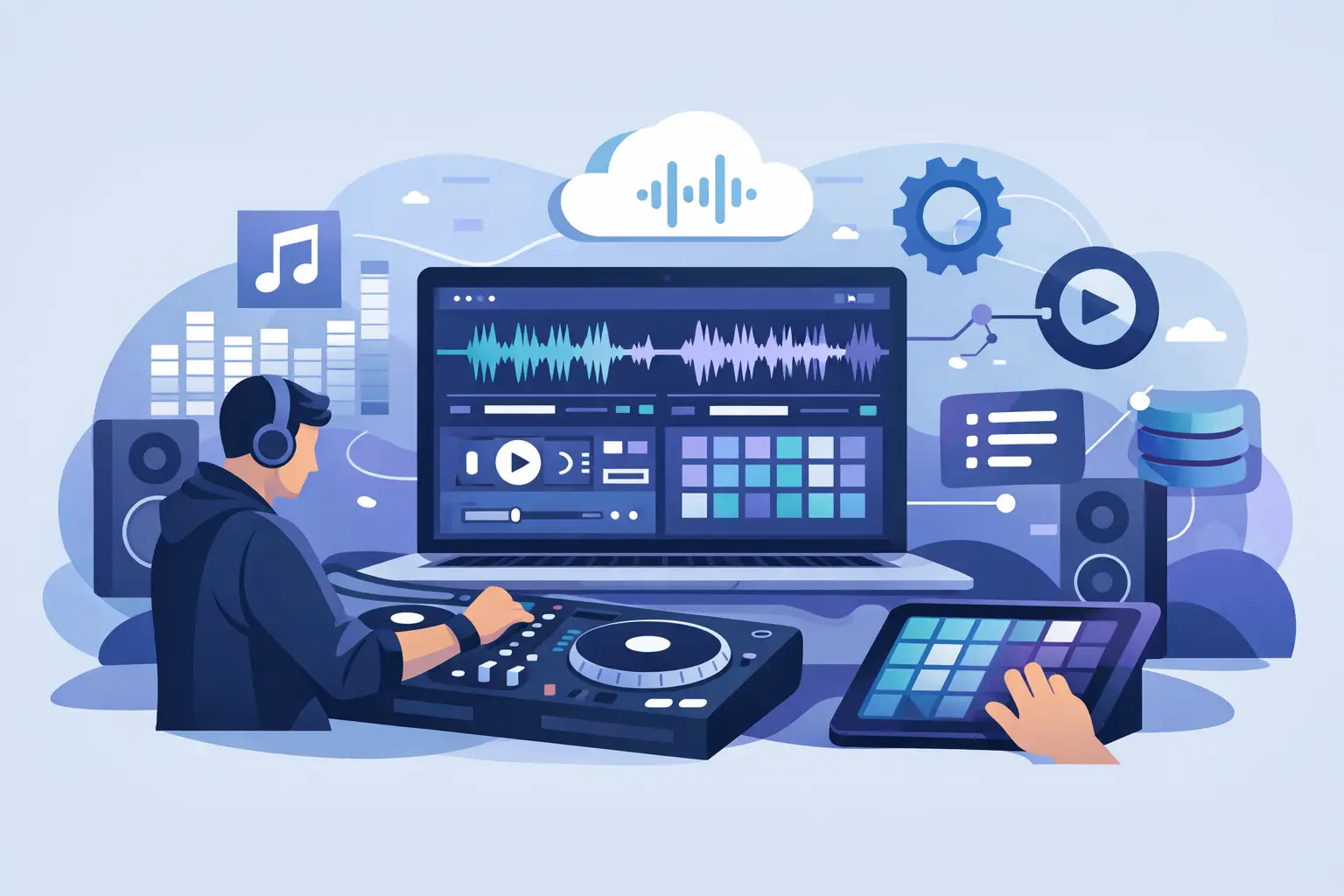
A packed dance floor does not care whether your tracks live on USB drives, vinyl, or a laptop. It cares whether the next record lands at exactly the right moment. So, why do DJs need software? Because modern DJ software turns a music collection into a performance system - one built to help you prepare faster, react smarter, and deliver a set that feels intentional from the first track to the last.
Software does not replace DJ skill. It gives that skill more reach. The DJ still chooses the music, reads the room, controls the energy, and makes the creative calls. The difference is that software handles the time-consuming and precision-heavy work that can get between an idea and a great mix.
Why DJs Need Software: Control Beyond Two Decks
Traditional DJing gives you the essentials: playback, cueing, pitch control, EQ, and the physical connection to your music. Those fundamentals still matter. But a DJ set today may need to move from a warm-up playlist to open-format requests, a video screen, a karaoke rotation, or a last-minute change in the crowd without losing momentum.
DJ software brings those moving parts into one workspace. It can display waveforms, beat grids, key information, cue points, loops, effects, samples, and library data right where you need them. Instead of searching through crates or relying on memory alone, you can see the structure of a track before you bring it in.
That visual feedback is not a shortcut around technique. It is a performance advantage. A clear waveform can help you spot an intro, breakdown, or vocal entrance at a glance. Beat information helps you make cleaner transitions. Hot cues let you jump directly to the part of a song that matters. When the room is loud and the pressure is real, fast decisions are everything.
Better Preparation Means Better Live Decisions
The strongest DJ sets usually begin long before showtime. Software gives DJs a practical way to organize an expanding library so the right music is available when the moment arrives.
A well-managed library can be searched by artist, title, genre, BPM, key, year, rating, or custom tags. That matters when someone asks for a specific song, when a client changes the plan, or when the dance floor suddenly responds to a style you did not expect. You are not scrolling through thousands of files hoping to remember the exact folder. You are finding the track and getting back to the mix.
Preparation also becomes more creative. DJs can set cue points at clean intros, vocal hooks, drops, and outro sections. They can build playlists for different parts of an event, then leave room to improvise. They can identify compatible tracks by tempo and musical key without treating those suggestions as rules.
The trade-off is simple: analysis data is useful only when it is accurate. A beat grid can be wrong on a live drummer, an old disco track, or an unusual edit. Smart DJs check important tracks, learn to adjust grids, and trust their ears over any visual display. Software should support your judgment, not make it for you.
Precision That Lets You Focus on the Crowd
Beatmatching by ear remains a valuable skill. It trains timing, listening, and confidence. But even experienced DJs benefit from tools that reduce mechanical distractions during demanding sets.
Tempo matching, sync options, quantized loops, and beat-aware effects can keep a performance tight while you focus on phrasing and crowd response. Used well, these features do not make every mix sound the same. They free you to attempt more ambitious transitions, layer percussion, build tension with loops, or make a quick correction when a song is not landing.
Consider a mobile DJ handling announcements, requests, and a full dance floor at the same time. Or a club DJ mixing four decks while timing an acapella over an instrumental. In those situations, software is less about doing less and more about doing more without sacrificing control.
The best approach depends on the DJ. Some performers prefer to manually beatmatch nearly every transition. Others use sync as a precision tool while pushing deeper into remixing and layering. There is no prize for avoiding a feature that helps you deliver a stronger set. The real standard is whether the audience hears a confident performance.
Software Makes a Set More Creative
A great DJ does more than play one complete track after another. They reshape familiar music into a unique experience. This is where software can change what is possible in real time.
Loops can extend a groove while you wait for the right moment to switch tracks. Samples can add a signature sound, a crowd chant, or a transition hit. Effects can create movement and drama when they are used with restraint. Stems take that flexibility further by separating elements such as vocals, drums, bass, and instruments, allowing DJs to create live mashups that would otherwise require a studio edit.
Imagine keeping the drums from one record rolling while bringing in the vocal from another. Or removing a vocal to make room for an MC. Or creating a clean transition out of a track with an awkward ending. These are not gimmicks when they serve the music. They are ways to make a set feel alive, personal, and impossible to copy exactly.
More tools do require better taste. Throwing effects over every transition can flatten the energy instead of building it. Constant mashups can make a set feel crowded. The technology gives you options; experience tells you when to leave space.
One Platform for More Than Audio
For many working DJs, the job is bigger than a club set. Weddings, school events, bars, corporate functions, and private parties often demand multiple formats in one night. A DJ may need background music during dinner, high-energy dance music later, video visuals on screens, and karaoke after that.
Software makes these formats manageable from a central performance environment. Video mixing allows visuals to move with the music rather than becoming an afterthought. Karaoke tools can help organize singers and rotations. Microphone and audio controls help the DJ shift between entertainment roles without rebuilding the entire setup.
This flexibility is especially valuable for DJs building a business. Taking on more kinds of events should not mean learning a completely different workflow every time. A platform that grows from bedroom practice to professional events helps protect your preparation time and keeps your performance process consistent.
VirtualDJ is designed around that range: accessible enough to start mixing quickly, yet equipped for audio, video, karaoke, live remixing, stems, and customized controller workflows when your gigs demand more.
Hardware Compatibility Keeps Your Options Open
Software becomes even more powerful when it works with the gear you actually want to use. A beginner might start with a laptop and headphones. A mobile DJ may rely on a controller, microphone inputs, and external screens. A turntablist may want timecode vinyl and low-latency response. A professional booth setup may involve mixers, media players, lighting, and backup devices.
The right software should not force a DJ into a narrow path. Broad hardware support means you can choose a setup based on your style, budget, and venue requirements. Controller mapping and customization can also put important functions exactly where your hands expect them to be.
Reliability matters here as much as features. Every DJ should know their system, test updates before important gigs, keep music files organized locally, and carry a backup plan. Software can make a performance more capable, but professional habits make it dependable.
The Point Is Not Technology - It Is the Moment
DJs need software because the modern job asks for speed, flexibility, organization, and ideas that can happen in the moment. It helps a new DJ learn the structure of mixing without unnecessary barriers. It helps an experienced DJ manage a deeper library, take more creative risks, and deliver across more types of events.
The screen is not the show. The crowd is. Use software to spend less energy hunting for tracks and more energy creating the next moment everyone remembers.