


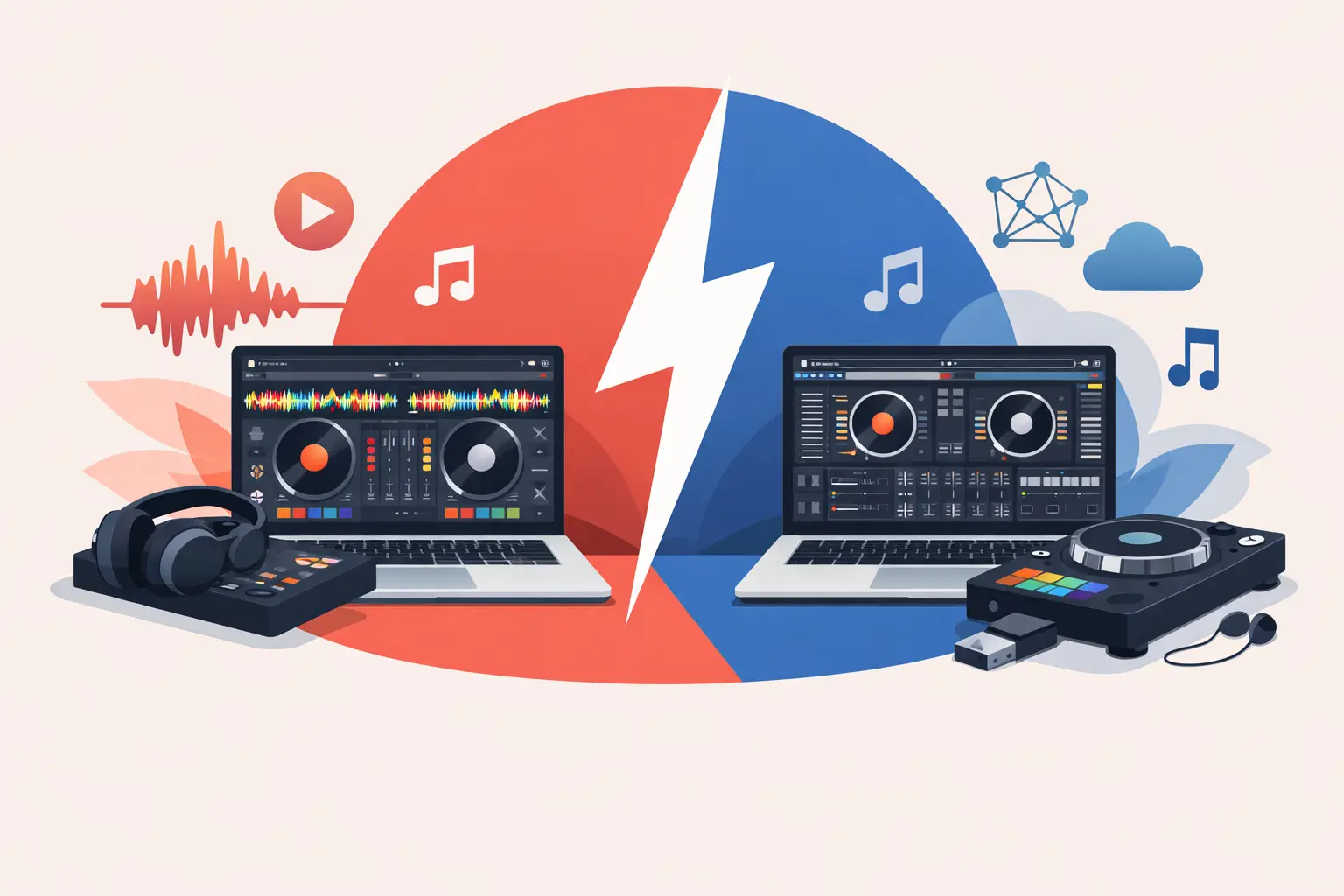
The gap between a good set and a set people remember usually comes down to flexibility. That is why the virtualdj vs rekordbox software debate matters so much. DJs are not just choosing a library manager or a waveform view. They are choosing how fast they can prepare, how far they can push a mix live, and whether their software helps them stand out or keeps them boxed into someone else’s workflow.
For some DJs, Rekordbox feels like the obvious lane because of its connection to Pioneer DJ club ecosystems. For others, that same tight ecosystem can feel limiting once they want more freedom, broader hardware support, deeper performance tools, or a setup that goes beyond standard club mixing. The real comparison is not just feature versus feature. It is control versus restriction, specialization versus versatility, and whether your software grows with you.
VirtualDJ vs Rekordbox software for real-world DJing
If your DJ life starts and ends with exporting playlists for a club booth, Rekordbox has a familiar place in that workflow. It is closely associated with Pioneer DJ hardware, and that matters if your main goal is preparing USB drives for CDJ-based venues. For DJs who want a software environment built around that path, Rekordbox makes sense.
But most DJs do more than one thing. They play private events, livestream, take mobile gigs, test new controllers, remix on the fly, work with video, host karaoke, or bounce between home practice and paid performances. This is where a more open platform starts to pull ahead.
VirtualDJ was built for that wider reality. It gives beginners an easy starting point, but it does not flatten out when your skills improve. It scales. You can start by learning phrasing and transitions, then move into stems, custom mappings, live mashups, video mixing, and advanced performance workflows without switching platforms or relearning your entire setup.
Workflow: prep-focused vs performance-focused
The biggest difference in virtualdj vs rekordbox software is mindset. Rekordbox is heavily prep-centered. It is strong when your process is based on organizing tracks, setting cue points, exporting media, and fitting neatly into a Pioneer-first environment. That can be efficient, especially for club DJs who value consistency from laptop to USB to booth.
VirtualDJ leans harder into live performance. It is designed for DJs who want to do more in the moment. Real-time stem separation changes how you mix because you are not limited to the original full track. You can isolate vocals, drums, melodies, or instrumentals and create transitions and mashups that would otherwise require edits prepared in advance.
That difference matters on stage. If a crowd shifts, your software should let you react, not just stick to the script. A prep-heavy workflow can feel safe. A performance-driven workflow can feel alive.
Hardware support changes everything
Software is only as useful as the gear it works with. This is one of the clearest lines between the two platforms.
Rekordbox is naturally strongest with Pioneer DJ hardware. That is not a flaw by itself. If you are committed to that ecosystem, it can be a straightforward fit. The trade-off is that your flexibility narrows when you want to use different controllers, experiment with mixed setups, or get more life out of gear you already own.
VirtualDJ has long stood out for broad hardware compatibility. That gives DJs more freedom to choose based on budget, layout preference, performance style, or venue demand instead of software limitations. If you are a mobile DJ switching between controllers, a scratch DJ dialing in a custom setup, or a performer who wants backup options, that kind of support is not a small bonus. It is operational security.
And for working DJs, reliability is not abstract. It means fewer compromises before a gig, fewer awkward gear surprises, and more confidence when your setup has to perform under pressure.
Stems, remixing, and creative headroom
This is where the comparison gets less subtle.
Modern DJing is not just about beatmatching cleanly. It is about creating moments that sound custom. Real-time stems open that door in a serious way, and VirtualDJ has pushed this area forward with a level of maturity that makes it useful in actual performance, not just as a novelty feature.
When you can remove or isolate parts of a track instantly, transitions get smoother, mashups get sharper, and recoveries get easier. You can pull vocals from one track over the groove of another, kill drums to reset the room, or rebuild energy without needing a pre-edited crate. That is a major creative edge.
Rekordbox has added more modern features over time, but its core reputation still leans more toward ecosystem alignment than category-defining performance freedom. If your style is straightforward club mixing, that may be enough. If your goal is to sound less predictable, more software freedom matters.
Video, karaoke, and multi-format performance
A lot of DJ software comparisons ignore the fact that many paid performers do more than audio sets. Wedding DJs, open-format DJs, bar residencies, event entertainers, and hosts often need to mix video, run karaoke, manage requests, and handle a wider range of media formats in one night.
This is a major advantage for VirtualDJ. It is not boxed into one narrow idea of what a DJ should be. It supports audio mixing, video mixing, karaoke hosting, live remixing, and large library management inside a single platform. For working professionals, that means fewer workarounds and fewer separate tools.
Rekordbox is more specialized. That can be fine if your world is built around one type of booth and one type of set. But if your business depends on versatility, specialized can quickly become limiting.
Learning curve and long-term value
Beginners often ask which platform is easier. The honest answer is that ease depends on what you are trying to become.
Rekordbox can feel approachable if your goal is to learn a standard club-prep workflow tied to Pioneer-style systems. There is a logic to it, especially for DJs who want to mirror what they expect to see in certain venues.
VirtualDJ is approachable in a different and more empowering way. It lowers the barrier to entry while still giving you room to grow into advanced features. You can get started quickly, but you do not hit a creative ceiling the minute you become more ambitious. That balance is a big reason so many DJs begin with it and stay with it.
Value is part of this too. Software should not force an upgrade in your entire setup just to keep moving forward. A platform with broad support, scalable features, and serious performance depth gives you more return over time because it adapts as your needs change.
Which DJ should choose which platform?
If you are a club-focused DJ who mainly wants to prepare playlists for Pioneer DJ environments, Rekordbox remains a practical choice. It fits that lane well, and pretending otherwise would not help anyone.
But if you want your software to do more than prepare tracks, the balance shifts fast. DJs who care about live creativity, hardware freedom, stems, custom performance workflows, video, karaoke, and broader gig versatility will usually find more headroom in VirtualDJ.
That includes a huge range of real performers: bedroom DJs growing into paid work, mobile entertainers who need one platform for different event types, scratch DJs building personalized setups, and open-format DJs who need to read a room and pivot instantly. For those users, software should expand your range, not narrow it.
The better question than virtualdj vs rekordbox software
The better question is not which platform is more popular in one booth type. It is which one helps you become a better, more creative, more adaptable DJ.
If your priority is following a fixed ecosystem, Rekordbox has a clear role. If your priority is unleashing creativity, mixing with fewer limits, and using software that keeps pace with how modern DJs actually perform, VirtualDJ is the stronger answer.
The future of DJing belongs to performers who can do more in real time, on more gear, in more settings, without sacrificing control. Choose the software that gives you room to build that future your way.