


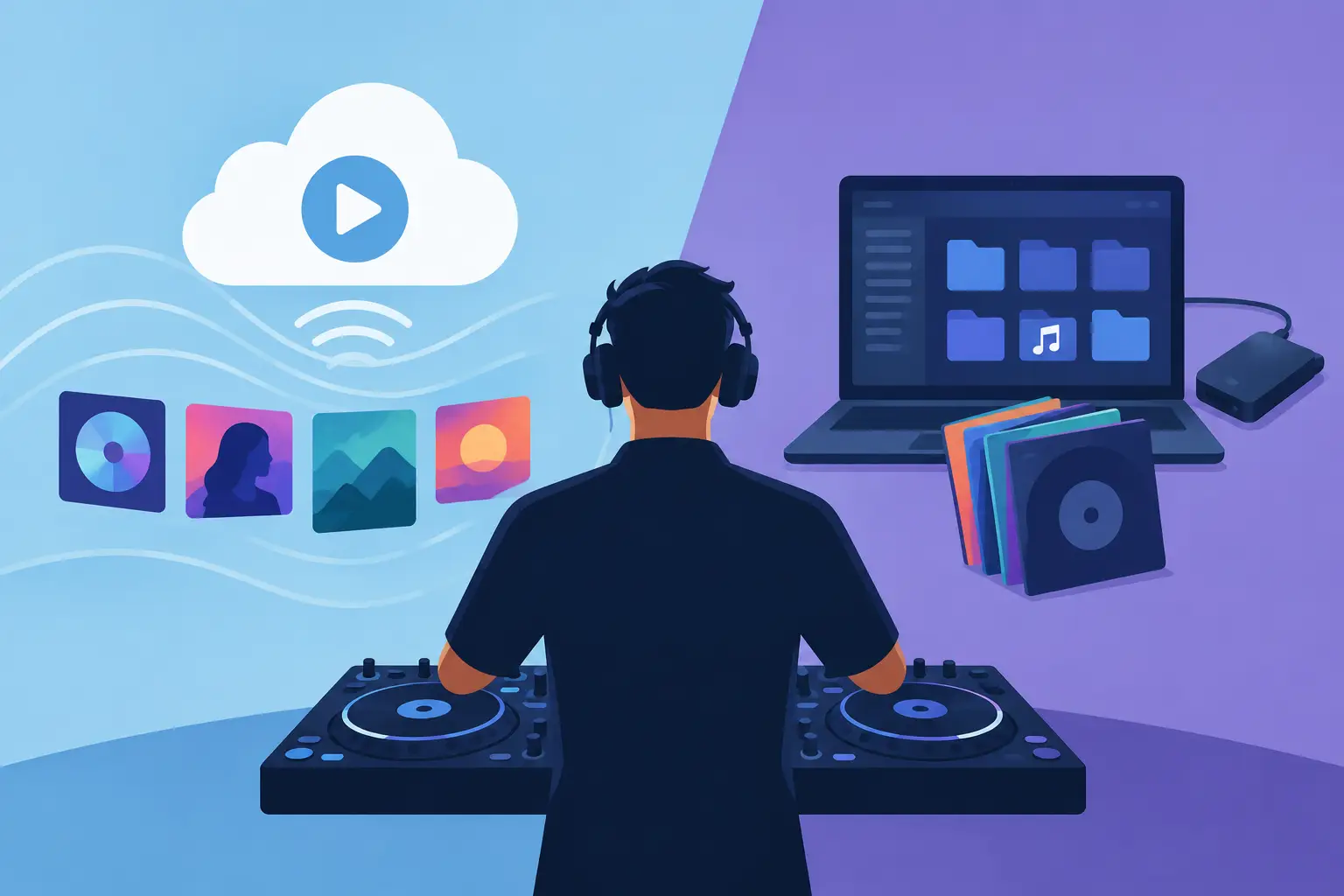
A packed room does not care where the next track came from. It cares whether the drop lands on time. That is the real question behind streaming versus local DJ files: not which option looks newer, but which one gives you the confidence and creative control to deliver when the room is waiting.
Streaming has changed music discovery for DJs. A nearly endless catalog can turn a last-minute request into a great moment instead of an awkward apology. Local files remain the performance foundation for DJs who cannot afford a loading wheel, a missing version, or a weak signal at the exact wrong time. The strongest setup is rarely about choosing one side forever. It is about knowing where each one wins.
Streaming Versus Local DJ Files in a Real Set
Streaming is built for range. Local files are built for certainty. That distinction gets sharper as the stakes rise.
A bedroom DJ trying new genres may get more immediate value from streaming. You can search deep catalogs, test tracks against your existing music, and learn what fits your sound without buying every song before you know it belongs in your library. For open-format DJs, mobile entertainers, and request-heavy events, that access can be a serious advantage. Someone asks for a current song, a throwback you did not expect, or a specific remix, and you have a better chance of finding an answer quickly.
But access is not ownership. A streamed track depends on a service connection, the platform's catalog availability, and the terms attached to that service. A song can disappear, an edit may not be available, and a venue's Wi-Fi can be worse than useless once a few hundred guests connect to it. Even a strong cellular connection can struggle in a basement club, a remote wedding venue, or a convention hall full of competing devices.
Local files live on your computer or approved external storage. They are there when the internet is not. Their waveform, cue points, beat grid, stems preparation, and file information can be analyzed before the doors open. You are working from the exact versions you chose, whether that means clean edits for a corporate event, extended intros for a club set, or personal edits that make your transitions sound like nobody else's.
For a paid performance, reliability is part of your reputation. Local files put more of that reliability in your hands.
What Streaming Gives You That Local Files Cannot
The obvious advantage is discovery, but it goes deeper than having more search results. Streaming lets you react to a crowd without carrying a massive, permanently downloaded collection. It can help you explore regional sounds before a destination gig, audition alternate versions of a song, or build a genre vocabulary outside the lane you usually play.
That flexibility matters when your set needs to evolve. A DJ who only brings a tightly curated local collection can be brilliant, but may have fewer options when the crowd shifts. Streaming can act as an expanded crate when a crowd suddenly leans into Afrobeats, Latin pop, indie dance, or a decade you did not expect to dominate the night.
It is also a lower-risk way to develop taste. Instead of collecting music blindly, you can test whether a track has the right energy, arrangement, and mixability for your audience. If it earns a repeat place in your sets, that is a strong signal to add a dependable local copy.
There are limits. Streaming catalogs are not identical to download stores, record pools, or promo services. The version you need may be missing, mislabeled, censored, shortened, or replaced. Specialty edits, intro versions, acapellas, instrumentals, and high-quality DJ tools are often where a personal local library pulls ahead.
Why Local Files Still Run the Booth
Local music files are not old-school baggage. They are a professional asset.
First, they protect your performance from connectivity problems. No DJ wants to explain that the track did not load because the venue router failed. A prepared local library lets you keep mixing through an internet outage, a subscription issue, or a catalog change. That is not glamorous, but it is the difference between a smooth night and a preventable disaster.
Second, local files give you more control over music quality and versions. You can choose the files that meet your standards, organize them accurately, and keep the exact edit you practiced. If you use video, karaoke, custom intros, mashups, or production elements, local storage becomes even more essential. Those performance assets are part of your show, not just songs in a search field.
Third, local files support a faster, more intentional workflow. Your best music should be organized by energy, genre, era, key, event type, and crowd response - not simply buried in a giant folder. Set cue points on your favorite transitions. Create dedicated crates for peak-time records, cocktail music, singalongs, clean versions, and emergency floor-savers. The result is less searching and more performing.
A local library also rewards preparation. When you know your files, you know the intro length, the break, the vocal timing, and the moment a track can rescue the room. That familiarity gives your mixing more personality.
The Cost Question Is Bigger Than a Subscription
Streaming can appear cheaper because the upfront cost is lower. That can be true for a new DJ, especially while learning and experimenting. But subscriptions are ongoing operating costs, and they do not create a collection you control outside the service.
Local files require more initial investment. You may buy tracks, source music through legitimate DJ-focused channels, and spend time cleaning metadata and managing backups. In return, you build a library that reflects your sound and remains available to you. Over years of gigs, that collection becomes one of your most valuable creative resources.
The practical comparison is not simply monthly fee versus purchase price. Ask what your work demands. If you play weekly open-format venues and receive unpredictable requests, streaming can save time and widen your options. If you perform weddings, clubs, private events, video sets, or internet-challenged venues, investing in local files is often the smarter insurance policy.
Build a Hybrid Workflow That Performs
For most DJs, the winning move is a hybrid workflow: local files for the music that carries your set, streaming for exploration and controlled flexibility.
Start by making your essential library local. That includes your proven openers, warm-up selections, peak-time tracks, closing records, requested staples, clean edits, signature transitions, and event-specific music. If a song is central to your identity or likely to be played at a paid gig, do not leave it dependent on a signal.
Then use streaming strategically. Search for new releases, test unfamiliar tracks, fill reasonable requests, and explore possible directions during preparation. When a streamed track proves itself, add a local version before the next serious performance. This turns discovery into a growing, dependable catalog instead of a temporary shortcut.
Backups matter just as much as format choice. Keep your performance library on your primary computer, maintain a second copy on reliable storage, and test your setup before leaving for the venue. Confirm that your playlists, cue points, databases, and hardware work as expected. A backup is only useful if you have actually tested it.
With VirtualDJ, DJs can organize local music, work with compatible streaming services, and keep the workflow focused on the performance rather than the friction. The point is not to choose technology for its own sake. It is to have more options when creativity calls, without sacrificing control when the room gets demanding.
Choose Based on the Gig, Not the Hype
If you are practicing, building musical knowledge, or playing flexible request-driven sets, streaming can expand your reach fast. If you are playing high-pressure events where interruptions are unacceptable, local files should remain your core. For many working DJs, a carefully prepared local library plus streaming as a secondary resource is the setup that makes the most sense.
Your music source should never become the weak point in your performance. Build the local foundation, keep discovery close, and walk into every set prepared to play the track the moment demands.