


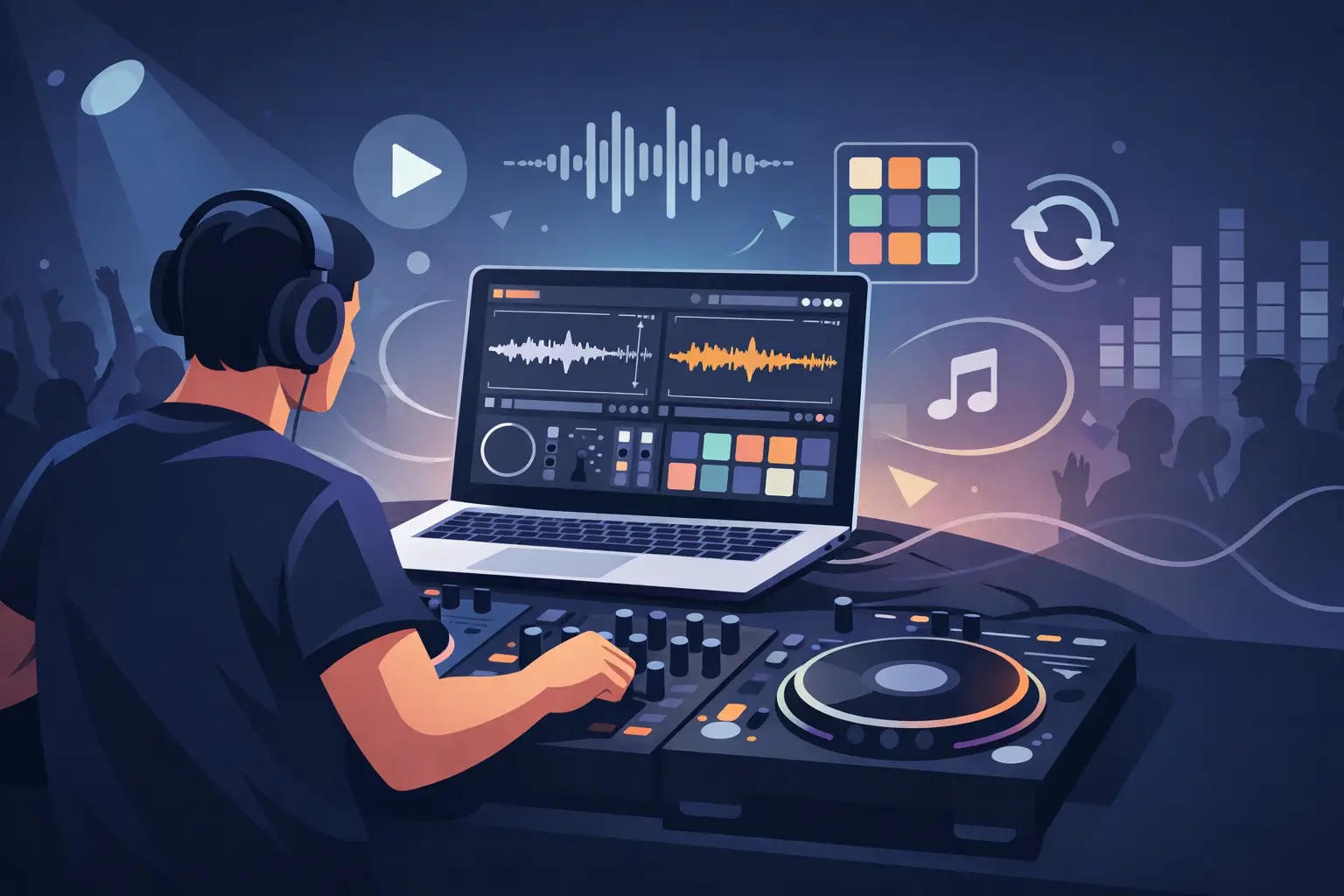
A packed dancefloor does not care how hard your setup was to build. It reacts to what happens in the moment - the surprise vocal drop, the instant mashup, the loop that turns a transition into a statement. That is exactly why live remix software for DJs matters. It is not just about mixing one track into another anymore. It is about reshaping music live, with enough speed and control to make the crowd feel like the set is happening for them, not at them.
For some DJs, live remixing means quick edits, hot cues, and effects that push energy at the right second. For others, it means stem separation, on-the-fly acapella swaps, performance pads, sample triggering, and layered transitions that sound closer to a custom bootleg than a standard mix. The best software handles both. It gives beginners a fast way to sound bigger, while giving experienced DJs the tools to build a signature performance style.
What live remix software for DJs should actually do
A lot of DJ platforms claim remix features, but not all of them are built for real live performance. Some are fine for basic looping and a few effects. That is useful, but it is not the same as software designed to let you deconstruct and rebuild tracks under pressure.
Real live remix software for DJs should let you isolate parts of a song, trigger samples with tight timing, manipulate loops without losing the groove, and keep everything responsive when the room is moving fast. If it takes too many clicks to get to a vocal, mute a bassline, or launch a transition sample, it is working against you.
There is also a difference between creative power and practical power. A feature list can look impressive on a product page, but if the workflow is clumsy, you will not use those features during a real set. The software has to feel immediate. You should be able to hear an idea and execute it before the moment passes.
The features that separate average tools from serious performance software
The biggest shift in DJ performance over the last few years has been real-time stems. This changes live remixing from a niche technique into an everyday weapon. Instead of waiting for pre-made edits, you can pull vocals, drums, bass, and melodic elements from a track as you play it. That opens the door to faster mashups, cleaner transitions, and more original set building.
Stems are only part of the story, though. Looping still matters, and not just for extending an intro. Great looping lets you build tension, create live breakdowns, and lock a groove while you prepare the next move. The best systems make loops easy to set, adjust, and re-enter without feeling mechanical.
Effects matter too, but this is where restraint pays off. A long list of effects is not automatically better. What matters is control, sound quality, and how naturally those effects fit into your workflow. Filter sweeps, echoes, beat-aware delays, and performance-friendly transitions tend to do more for most sets than a pile of novelty options.
Sample banks and performance pads are another major piece. They let you add drops, vocal hits, drums, stabs, and custom branding elements without breaking the flow. For mobile DJs and open-format DJs, that can mean stronger crowd interaction. For club DJs, it can mean more identity in every transition.
Then there is hardware integration. If the software does not map well to your controller, mixer, or DVS setup, live remixing gets slower and riskier. The best platforms support a wide range of gear and give you room to customize the workflow instead of forcing you into one fixed performance style.
Why workflow beats hype
Many DJs do not need the most complex production-style environment. They need speed, reliability, and room to create without second-guessing every move. That is where software choice becomes less about marketing and more about performance reality.
If you are a beginner, an overloaded interface can kill momentum. You want remix tools that feel intuitive enough to start using right away. Hot cues, loops, sampler triggers, and basic stem controls should be easy to find and easy to trust. The goal is not to learn every advanced trick on day one. The goal is to start making your sets more dynamic now.
If you are a working DJ, your standards are different. You need software that stays stable for long sets, responds quickly, and scales with more advanced routines. You may need video support, karaoke support, or custom controller mapping. You may also need a platform that works across different gig types without forcing you to switch systems. That flexibility matters more than flashy branding.
Live remix software for DJs in real-world sets
In a club set, live remixing often shows up as energy control. You are not trying to perform a full studio reconstruction of every song. You are using stems, loops, and effects to hold momentum, tease familiar hooks, and create transitions that hit harder than a clean crossfade.
In open-format rooms, the value gets even bigger. Fast genre changes are part of the job. Being able to loop an outgoing section, strip drums from one track, pull a vocal from another, and bridge the gap with samples can make the difference between a jarring switch and a moment that feels intentional.
For mobile DJs, remix tools can help stretch songs for announcements, create cleaner edits for mixed-age crowds, and adapt on the fly when requests change the direction of the night. For scratch DJs and performance-focused DJs, responsive pads, cue juggling support, and stem-based control create more room to do something memorable.
That is the common thread. Live remixing is not one style. It is a set of capabilities that helps different DJs solve different problems in front of real people.
What to look for before you commit
The first question is simple. Does the software help you perform better right away, or does it promise future potential that never really shows up in your hands? A platform can be technically deep and still be the wrong fit if basic actions feel slow.
Look closely at stem quality, loop handling, effect timing, sample triggering, and search speed. Those are the features you feel during a live set. Also consider how well the software supports your current hardware and whether it gives you room to grow. A beginner may start on a small controller, then later move to a more advanced setup or DVS system. Good software should scale with that path.
It is also worth thinking about your format. If you play video, host karaoke, or work mixed event calendars, your remix software should support those performance demands without turning into a compromise. Some platforms are narrow by design. Others are built for DJs who wear more than one hat.
One platform that stands out here is VirtualDJ. It has earned its position by making advanced tools available to a huge range of DJs, not just specialists. Real-time stem separation, flexible performance controls, deep hardware support, video and karaoke capability, and an easy path from beginner use to professional performance make it a serious choice if you want creative freedom without giving up reliability.
The trade-off every DJ should understand
More remix power can also create more temptation to overdo it. Just because you can isolate every stem, stack effects, and trigger samples every eight bars does not mean you should. The best live remix sets still serve the crowd first.
That is why the right software does more than add features. It helps you stay musical. Fast access, clean timing, and predictable control keep you focused on performance instead of menu hunting. When the software gets out of the way, your choices get better.
Some DJs need a stripped-down workflow with a few high-impact tools. Others want a deeper performance environment with custom mappings, layered stems, and complex pad pages. Neither approach is automatically better. It depends on your format, your experience, and how much you want to reshape tracks live versus simply sharpen your transitions.
The real win is choosing software that makes your best ideas easier to perform under pressure. If your current setup only lets you mix tracks, you are leaving a lot of crowd energy on the table. The DJs getting remembered are not just playing songs. They are rebuilding the moment in real time - and the right tools make that possible.