


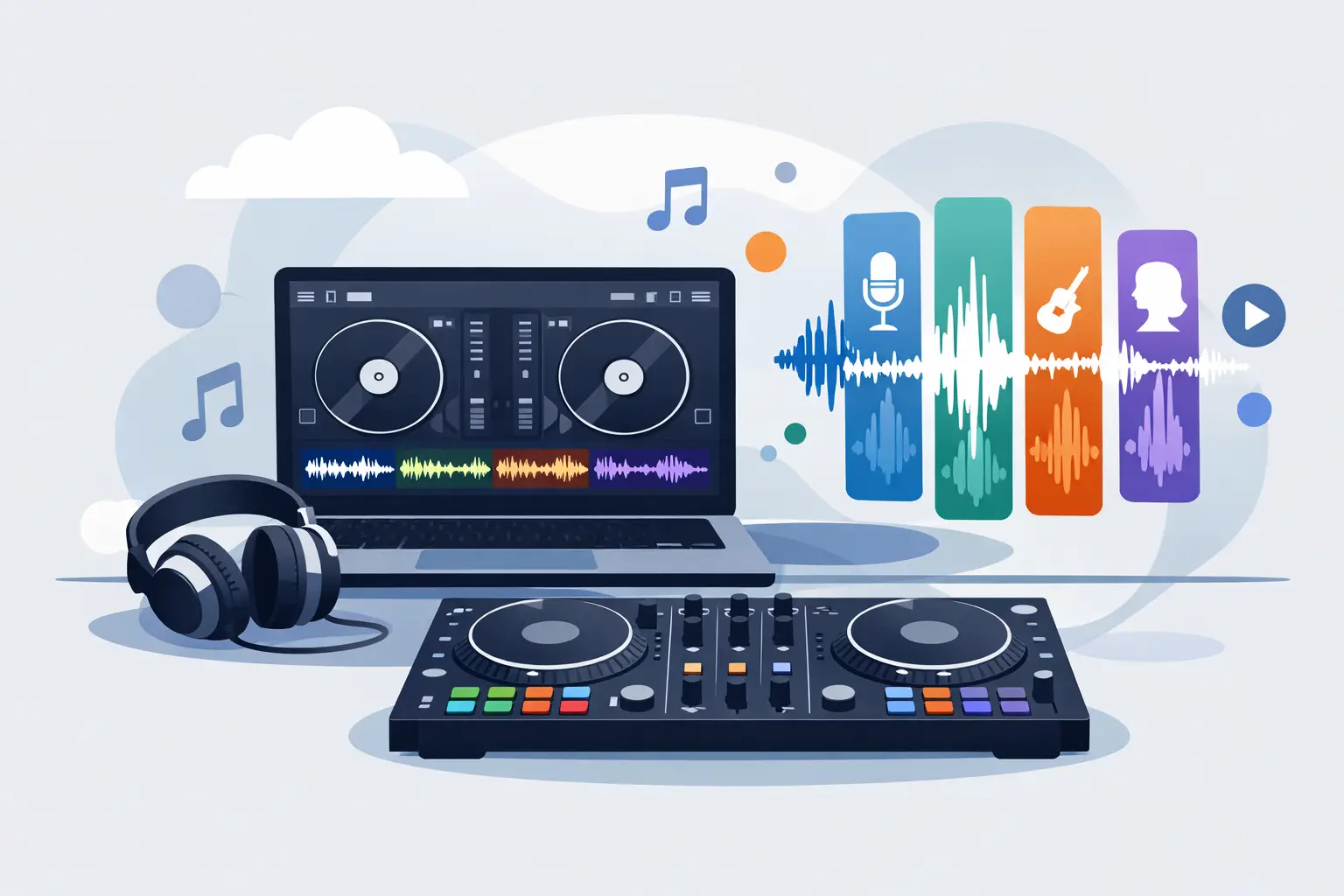
The crowd is singing the hook, but the vocal is fighting your incoming track. A few years ago, that moment meant compromise. Now, with dj software with stem separation, you can pull vocals, drums, bass, and instrumentals apart in real time and shape the mix the way you actually hear it in your head.
That shift matters because stem separation is not a gimmick feature. It changes how DJs transition, remix, recover from awkward song combinations, and build original moments on the fly. If you are comparing platforms, the real question is not whether stem separation exists. It is whether the software makes it usable under pressure, with sound quality and control that hold up in a live set.
What DJ software with stem separation should actually do
A lot of software can claim stem separation. The difference shows up when the room is full, the monitor is loud, and you need the result instantly. Good stem separation should sound clean enough for performance, respond fast enough for live use, and give you direct control without forcing you through extra prep steps.
That means you should be able to isolate vocals for a quick acapella transition, cut drums to avoid clashing grooves, or remove bass from one track so the low end stays tight. The best systems let you do this without turning your workflow into a science project. If it takes too many clicks, too much analysis time, or too much guesswork, you will stop using it when the pressure is on.
For beginners, this opens the door to better sounding mixes much earlier. For experienced DJs, it creates more space to take risks, test mashups live, and fix conflicts that would otherwise force a hard transition.
Why stem separation changes the way you mix
The biggest benefit is freedom. Traditional DJ mixing often means working around what is already baked into a track. With stems, you are not stuck with the full arrangement at every moment. You can keep the groove but lose the vocal. Keep the melody but strip the drums. Bring in an acapella over a beat that was never meant to support it and make it feel intentional.
That opens up cleaner transitions. Instead of waiting for the perfect intro or outro, you can create your own mix points. If two songs are harmonically right but rhythmically busy, remove the drums from one. If the vocals are competing, kill one vocal and let the stronger phrase lead. If a track has too much going on, stem controls let you simplify it in real time.
It also changes live remixing. Stem separation gives you a faster path to edits that used to require pre-made tools, studio prep, or dedicated remix packs. Now the DJ booth can become part performance space, part remix workstation.
There is a trade-off, though. Not every song separates equally well. Dense mixes, heavily processed vocals, and older masters can create more artifacts than clean modern productions. That is why quality matters, but so does expectation. The goal is not laboratory-perfect extraction every time. The goal is musical control that sounds strong in real-world performance.
The best DJ software with stem separation is built for live use
This is where a lot of platforms separate themselves. Some offer stem technology, but it feels bolted on. Others make it part of the performance workflow from the start.
The best dj software with stem separation gives you real-time access during a set. You should be able to trigger stem pads, map controls to hardware, and integrate stems into your cueing, effects, and transitions without breaking your rhythm. If you have to stop and think about the feature, it is not helping enough.
Live usability means a few things. First, the software needs speed. Second, it needs stable performance on the kind of laptop DJs actually use. Third, it needs flexibility across different styles of DJing. A club DJ may want instant vocal isolation for fast blends. A mobile DJ may want to clean up edits and extend song options across open-format sets. A video DJ may want that same control while managing visuals. A karaoke host may value the ability to manipulate backing elements in creative ways.
That is why advanced stem separation is more than a checkbox feature. It becomes part of the platform’s identity. The strongest software treats stems as a core performance tool, not just a fun demo feature.
What to look for before you choose
Start with sound quality. If the separated vocal sounds brittle or the drum stem leaves too much residue, your transitions will feel messy. Some artifacting is normal, especially on difficult source material, but the best results stay musical enough for a loud room.
Next, look at control. Can you isolate stems individually? Can you mute or emphasize vocals, drums, bass, and instrumentals with dedicated controls? Can you apply effects to a single stem instead of the whole track? That kind of precision is what turns stem separation from novelty into advantage.
Hardware support matters too. If you use a controller, mixer, or DVS setup, stem controls should fit naturally into your rig. Touchscreen controls may be fine at home, but in a live environment many DJs want tactile access they can trust without staring at the laptop.
Then consider workflow. Some DJs are happy to pre-analyze a library before a gig. Others need immediate results because requests, crowd shifts, and last-second ideas are part of the job. If your work is unpredictable, real-time stem performance is far more valuable than a feature that only shines in planned sets.
Library management is another factor people overlook. Stem separation is powerful, but it works best when paired with strong browsing, cue points, saved loops, playlists, and search tools. Great performance features lose value if finding the right track takes too long.
Who benefits most from stem separation
Almost every type of DJ can use it, but the use case changes.
New DJs benefit because stem separation makes problem-solving easier. You can practice transitions with less fear of vocal clashes or muddy low end. That shortens the learning curve and helps your sets sound more polished sooner.
Open-format DJs probably gain the most obvious advantage. When your set moves across decades, genres, and energy levels, stems let you create bridges that would be difficult with standard track playback alone. You can rebuild transitions in real time instead of relying only on original song structure.
Club DJs get more freedom to keep momentum. Instead of waiting for ideal phrasing, they can reshape tracks on the fly and preserve energy without forcing abrupt changes. Scratch DJs can use stems for more creative routines, especially when juggling vocal phrases or cutting over selected elements. Mobile DJs gain flexibility for requests, mixed-age crowds, and events where adaptability matters more than genre purity.
If you work video or karaoke, the value expands even further. In those environments, software has to do more than just play songs. It has to support a broader show. Stem separation becomes one more tool that helps you stay in control of the room.
Why one platform stands out
The strongest option in this category is the one that combines real-time stem separation with the wider tools DJs actually need to perform. That means mixing, remixing, hardware integration, flexible library control, and dependable live behavior all in one place. VirtualDJ stands out because it treats stem separation as part of a complete performance system, not an isolated feature designed for marketing screenshots.
That matters whether you are mixing at home, streaming, playing clubs, or handling all-night event work. You get the creative upside of stems, but also the larger platform needed to put that power to work. For beginners, that means fast access to advanced tools without a steep wall. For pros, it means the freedom to push further without giving up reliability.
There is still an it-depends factor. If your laptop is older, real-time processing demands can affect your ideal setup. If your music library includes rough recordings or unusual masters, some tracks will separate better than others. But those are practical realities, not deal-breakers. What matters most is whether the software consistently gives you more control than the old all-or-nothing track model.
The future of DJ software with stem separation
Stem separation is quickly becoming part of the new baseline, but not all implementations are equal. The leaders will be the platforms that keep improving speed, clarity, and hands-on control while fitting stems into the rest of the DJ workflow. That is what turns innovation into something you actually use every night.
If you want software that helps you mix better, recover faster, and create sets that sound more personal, stem separation is no longer optional. It is one of the clearest signs that DJing has moved from playback toward live reconstruction. The best choice is the platform that lets you use that power without slowing you down - because when inspiration hits in the booth, the software should keep up.